The "Double Joy" character, 囍 (xǐ), is one of the most widely recognized and beloved characters among Chinese people, including overseas Chinese communities. Along with 福 (fú — blessing/fortune) and 龙 (lóng — dragon), it is one of the three most frequently used characters in folk culture.

The character 囍 is composed of two 喜 (xǐ) characters placed side-by-side. Let us first look at the historical evolution of the single character 喜.
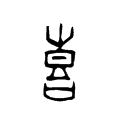
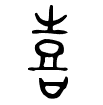
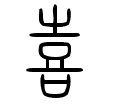
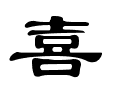
(From left to right: Oracle Bone Script, Bronze Script, Small Seal Script, and Clerical Script)
The top portion of the Oracle Bone Script is 壴 (pinyin: zhù),

which means "drum." Someone might ask: Why is a horizontal stroke missing from the middle of the character 壴here? This single horizontal line serves as an ideographic indicator (zhǐshì),
representing the drumhead being struck—in other words, a drum currently
being played. The absence of this stroke signifies a drum at rest.
While 壴 was discarded during the simplification of Chinese characters, it still exists within traditional characters today.
The bottom portion is the character 口 (kǒu —
mouth). In ancient times, entertainment and performances already
existed; when the drumbeats resounded, the show would begin, and the
audience would laugh so hard their mouths couldn't close. Therefore, beating the drum + mouth = joy (喜).
Because the character 喜 can be found in Oracle Bone Script, we know it appeared more than 3,500 years ago. However, the Double Joy character (囍)
appeared much later. Legend has it that it was created by Wang Anshi, a
famous statesman of the Northern Song Dynasty, though this remains a
folk legend with no definitive historical proof.
The
Double Joy character is deeply loved by ordinary people because it
implicitly conveys "double happiness" or "joy upon joy." It is most
commonly used in wedding ceremonies and for decorating bridal chambers.
The vast majority of people get married—some even multiple times—so
almost everyone ends up using the Double Joy character at some point.
Even for the very few who remain unmarried for life, their family
members, relatives, and friends get married, requiring them to attend
weddings. Thus, no one truly escapes the 囍 character.
Yet,
what is astonishing is that over its nearly thousand-year history, this
widely adored and universally used character has never been included in
formal, standardized dictionaries. For instance, Shuowen Jiezi, the Xinhua Dictionary, the Contemporary Chinese Dictionary, and even the online database Han Dian have completely omitted the character 囍.
Strictly speaking, this implies that the character has never been
officially recognized by authorities, making it a "non-standard
character." Another way to phrase "non-standard character" is a "miswritten character" or "typo" (cuòbiézì).
Remarkably, no other "typo" in history has been widely used for a
thousand years without ever facing a single shred of criticism.
Shuowen Jiezi dates back to the Han Dynasty. If the story of Wang Anshi creating the character is true, 囍 appeared more than nine hundred years after Shuowen Jiezi was compiled, making its omission there entirely understandable. However, its exclusion from modern references like the Xinhua Dictionary, the Contemporary Chinese Dictionary, and Han Dian is highly surprising, especially since no official explanation has ever been provided.
When previously answering the question "Why hasn't the character 囍 been included in standard dictionaries?", Gemini stated:
"The character '囍'
did not enter standard dictionaries because, throughout its long
history, it chose a path toward becoming an 'artistic and folkloric
totem' rather than a 'daily linguistic tool.'"
This explanation seems to make sense on the surface, but it isn't entirely convincing. For example, don't the characters 龙(dragon) and 福 (blessing)
also represent "artistic and folkloric totems"? Yet, dictionaries have
no problem including them. Furthermore, the shift of the character 囍 toward becoming an "artistic and folkloric totem" was not its choice, but rather the choice of the people.

