Tuesday, January 25, 2022

Were Chinese characters created by right-handed?

About ten years ago, I taught Chinese in a Chinese school in New Jersey. There was a 11 years old, left-handed girl in my class, let me call her R. I taught students to write shell bone script, they didn’t have problem. I then taught them big seal, small seal script, they didn’t have problem too. Because all those scripts are lines with the same width, similar to English, easy to write. 


Character Wood - From left to right: shell bone, big seal script, small seal script.

Next, I taught them to write clerical script. 

All right-handed students had no problem to write it with brush. However, R had trouble to write it because the strokes are not all straight and same width, especially the right-falling stroke in the lower part of the right side, which is the most typical stroke of clerical script “蚕头燕尾” (silkworm head and swallowtail). Character Wood has no silkworm head, but swallowtail, which has the widest part near the right end with a round end. The stroke is a narrow – widen – narrow from the up-left to down-right.

Right-handed could draw it by gradually pressing down the brush when pulling the brush first then rise it up gradually to the right bottom corner. However, R, left-handed, had to push the brush down and forward to the right bottom corner. The brush is soft, difficult to control when you push it forward and rise it up gradually to get a round stroke end.  

It is completely different from the writing English letters with hard pen, the strokes of letters are all the same width, left-handed could pull the pen from left to right without problem.  When you use soft brush to write stroke width not consistent, the difficulty is too big to overcome. 

I had not realized the problem until I saw her struggle in clerical script. I suggested her write with right hand, but she didn’t want to. She kept struggling to end of the semester, didn’t come back next semester. However, her elder sister, right-handed, was the best student in the class, won multiple first prize in Chinese calligraphy competitions.

I started to think “Were Chinese characters created by right-handed?”. Why are the characters easy for right-handed, but difficult for left-handed? Why don’t we hear any famous left-handed calligrapher in Chinese history? 

I had the thought for long time but never started to do the research until recently. I searched some shell bone script, bronze script, big or small seal script, and clerical script, tried to find some clue in this field.

The following is my summary of my research.

Shell bone script (~ 3500 + years ago) strokes are lines, the strokes are no changes in thickness, which are same as English letters. It is easy for left-handed to write even with soft brush.


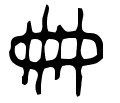
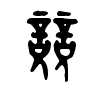
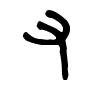
Shell bone script, from left to right: Again (又), Mountain(山), Volume(册), Compete(竞争)

However, we can see that the character Again is a side view of a right hand, which is easier for right-handed to draw, a little bit more difficult for left-handed.

Bronze, and big seal scripts (~ 3000 + years ago) are similar, strokes have a little bit change in thickness, some curves, still easy to left-handed.

Big seal script, from left to right: Again, Mountain, Volume, Compete

Small seal script (~ 2200 years ago) is more restrict on line width, the strokes are no changes in thickness, easier to write for both handed.


Small seal script, from left to right: Again, Mountain, Volume, Compete.

Clerical script (~2000 years ago) has changes in stroke thickness, sometimes very big.

Let’s see the character Again, the one on the far left. The falling-right stroke, the thickness on the right bottom end is much wider than that on the left up. The third character Mountain has the long horizontal stroke, the right end is the widest part of the stroke. Also, the far right one, character Compete, the right bottom curve is the widest part of the character. The right-handed could press the brush down hard while pull the brush to right or right downward, then gradually lose the pressure while pull the brush out. However, the left-handed can only push the brush to right or right downward, can’t get the tips of the end of strokes because the brush hair is bent backward. 

Therefore, we can see that the clerical script was created by right-handed, and for the right-handed.

Now, you may ask if other scripts were created by right-handed?

Let’s see the following characters.
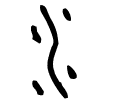
Shell bone script, from left to right: Water, Friend, Father, and Eye.

The three characters on the left have big stroke(s) falling right down, the character Eye has right up strokes. All the strokes are easy for right-handed to draw. However, it is still not strong enough to say “The shell bone script was created by right-handed”.

I think that the best evidence are the following characters.

From left to right, Brush (shell bone script), Write (shell bone script), Brush (big seal script)

The middle of all three is brush, the right up is hand, right hand holding the brush. The right one three fingers are across the shaft.

We are confident to say that the shell bone, big seal scripts were created by right-handed too. Bronze script is very similar to shell bone and big seal scripts. The small seal script is very similar to big seal script. So, all the old scripts were created by right-handed.

In Chinese history, there has never been a famous calligraphist who is left-handed, all famous calligraphists in Chinese history are right-handed, which is another strong evidence to support my claim “Chinese characters were created by right-handed”.

The reason of above fact is that you can’t write or draw Chinese characters with soft brush by left hand, which is different from writing English with hard pen. If you don’t believe what I said, just buy a brush on Amazon, and try to write English letters with the brush by left hand, you will find how difficult to do so. 


 Note: Update information


1, Amazing Chinese Characters blog has changed name to Learn Chinese with Pictography, and changed its URL address too, the new URL is


Learn Chinese with Pictography.blogspot.com/


2, Pictographic Chinese Calligraphy blog has changed name to Chinese Pictographic Calligraphy, and the new URL is


Chinese Pictographic Calligraphy.blogspot.com/


You are welcome to access the new sites for Chinese learning. Please update your bookmarks.


Friday, January 7, 2022

How should we look at Chinese Calligraphy?

 1, The oldest Chinese characters are pictography.

Oldest script characters (shell bone script, bronze script, and big seal script), are contour outline, even simpler.

From left to right:

Child (Big seal script, ~ 3000 years ago)

River (Big seal script)

Melon (Shell bone script, 3500+ years ago)

They are drawings, you see pictures.

2, Chinese characters lost pictography.

When Chinese character evolved into small seal script, then clerical script, the pictography of the characters is disappeared, writing characters is more like writing a language which can translate the writer’s ideas.

From left to right

Child (clerical script, ~ 2000 years ago to current)

River (clerical script)

Melon (clerical script)

The pictography features are lost.

3, About 2500 years ago, Chinese calligraphy became a carrier for letters, books, and documents. For long time (hundreds to one thousand years), Chinese calligraphy had been used just for communication as a language, not an art. There were no professional calligraphists who lived rely on writing calligraphy until a few hundreds of years ago. In comparison, there were professional painters long long time ago.

The most famous Chinese calligraphists, 王羲之 - Wang-Xizhi (Sui Dynasty, -), 颜真卿 – Yan-Zhenqing (Tang Dynasty), and 苏轼 – Su-Shi (Song Dynasty, ), all didn’t have calligraphy scrolls which are so popular that every Chinese family has one or more hanging on the walls. Their artworks are drafts with many errors and altering because they didn’t write calligraphy as an artwork, just normal letters, articles.

The most popular form of Chinese calligraphy is a Chinese poem written in Chinese calligraphy, a combination of poem and calligraphy, which is powerful expression of artistic feelings. The popular scripts used are running script, clerical script, and clerical script. Most scrolls hanging on the walls of Chinese families are this kind calligraphy artworks

4, Chinese calligraphy is not like fine art, but a unique art

Because it is based on Chinese characters which has its own meaning, and pictography in oldest script specifically, but late scripts lost the pictography, more like language not still not a pure language. It is a carrier for poems, and aphorism. So you have to know Chinese poems, aphorism well, and calligraphy too to be able appreciate Chinese Calligraphy artworks, which is too difficult to do for foreigners.

You may understand Chinese paintings, because they are similar to western or other foreign paintings. You may understand Chinese ceramic art, because they are similar to glass art. You may understand Chinese music, because they are similar western or other music. Any Chinese art, you can find a similar foreign art, but there is NO similar foreign art to Chinese calligraphy, NONE, ZERO.

This is why so few foreigners who know Chinese calligraphy well.

5, Can we overcome the challenges?

In the past ten years, I have tried to find a way to let non-Chinese speakers be able to understand and appreciate Chinese calligraphy, I created Pictographic Chinese Calligraphy, which emphasizes the pictography of Chinese characters. Basically, you see the oldest script, like shell bone script, which is a drawing same as I mentioned above. It is the oldest Chinese Calligraphy, you see pictures, not complicated current Chinese characters lost pictography. However, the characters are written by brush, and exactly or very close to the old scripts. No matter how much Chinese you know, you can understand, and appreciate the artworks.

Where the water flows, a canal is formed - 水到渠成.

The character in the artwork is shell bone script of Water.

Which is a river with 4 dots (water drops) because ancient Chinese got water from the water. I just drew many it from the small to big, which looks like a river flowing from far to near.

You don’t need to know Chinese to understand the work.

Deer in the forest - 林中小鹿

There are two characters in the work

1, Deer (shell bone script)

2, Forest (shell bone script)

Do you understand the work? Of course, it is just a drawing.

This is what I do, to show pictography of Chinese characters (old scripts) in my calligraphy artwork, everyone can understand and appreciate. This is the oldest Chinese Calligraphy, picture-like art, everyone understand, a best way to learn Chinese Calligraphy for foreigners.

If you are interested in this kind Chinese calligraphy. You could click the link to see more Pictographic Chinese Calligraphy (1) Fly - 飛, you get the first post “Fly” page, which explains what the Fly character original meaning, and pictographic drawing. On the right side of the page, you can see “Blog Archive”, there are links for other posts, just find one post you are interested, and click the link to see the artwork in another page. Every page has the “Blog Archive” links, you don’t need to back to the original page, just click on any link on that page, you can go a new post page.


Note: Update information


1, Amazing Chinese Characters blog has changed name to Learn Chinese with Pictography, and changed its URL address too, the new URL is


Learn Chinese with Pictography.blogspot.com/


2, Pictographic Chinese Calligraphy blog has changed name to Chinese Pictographic Calligraphy, and the new URL is


Chinese Pictographic Calligraphy.blogspot.com/


You are welcome to access the new sites for Chinese learning. Please update your bookmarks.


Saturday, November 23, 2019

Chinese Calligraphy History (13) What is the original meaning of Yin-Yang (阴阳)?

Yin - Yang is the most important in Chinese philosophy for more than 3000 years.

What is its original meaning from the view of pictography back to 3000+ years ago?

The shell bone script for character Yin is not found, so we start the bronze script for the character,


Left is a cliff, ancient Chinese lived in caves in the bottom of cliff.


From their view, they see cliff all the time.
On the right of the script, the top is mouth (the triangle), the bottom is cloud. Ancient Chinese believed that there is a King in the sky who is in charge of weather.  When he spits clouds from his mouth, it is a cloudy day.

Yin is the shade of the cliff, or the cliff under shade.

The shell bone script for character Yang is


The left is same as the left of Yin: the cliff. The right top is character Sun


The bottom part is the sunlight by 《象形字典》(Dictionary of Pictography).


Yang is the sunshine side of the cliff, or cliff under sunshine.

The small seal script for character Yin,


the left is the cliff, and the right are mouth (top) and cloud (bottom).

The small seal script for the character are sun (top) and sunshine (bottom)


Let us put them together


which is Yin-Yang, shade of cliff and sunshine of cliff.

The clerical script for Yin-Yang

similar to small seal script.

Let see the famous diagram below


It is called Yin-Yang diagram or Tai Chi diagram, the best diagram for the principle of Yin-Yang.

Let's make a circle virtually from the top black spot clock-wisely

1, We start at the top point (0 degree), move along the curve clockwise, we have the most white (Yang) with a small black spot (like the head of white tadpole or the tail of the black tadpole) meet more and more black area (Yin increases), and white is getting less (Yang decreases).

From the concept of shade and sunshine, we start at 12 PM, the brightness of the day. We go afternoon, sunshine side is getting weaker, and the shade side is getting stronger.

2, We continue to move clockwise, when we get 180 degree (the bottom of the circle), we reach the  point there is most black (Yin), and least white (Yang). It is the Yin extreme point.

From the concept of shade and sunshine, we get to midnight, the cliff's brightness almost all gone,  it is covered by shade or darkness.

3, we continue to move clockwise, we meet less black (Yin), and more white (Yang).

From the concept of shade and sunshine, the cliff has more bright, and less darkness during 12 - 6 AM.

4, continue to move clockwise, we come back to the starting point with the most white (Yang) and least black (Yin), we reach the Yang extreme point.

From the concept of shade and sunshine, the cliff begins to have more bright, and sunshine comes back, and gets stronger.

The above is the original meaning of the Yin-Yang.

Now people may see Yin-Yang below (simplified characters)
阴阳

The Yin
阴
The left is ear radical but meaning cliff, the right part 月 is Moon. 

The Yang
阳

The left is cliff, the right 日 is Sun.  This change is big.

月(Moon), and 阳 are two parts of the day. 月 represents night, and 日 represents day. The day could change to night, and visa verse. The relationship is similar to that of shade and sunshine, even though it may not as good as the shade/sunshine. 月 and 日 is not mutual containing and mutual transformation as shade/sunshine or darkness/brightness but they related to night/day which has very similar relationship to shade/sunshine.

In addition, this kind relationship (月/日) has dramatically expended the application range of Yin-Yang. People use Yin-Yang relationship in Man/Woman, Heaven/Earth, Summer/Winter, Fire/Water, and many more, each has the same relationship as that of Moon and Sun.  


Friday, March 1, 2019

Chinese Calligraphy History (4) How could people to express abstract meanings: The Ideogram characters

The Ideogram characters

I was asked that Chinese characters are pictography, characters are pictures from the physical shapes, how could people express the abstract meanings, like verbs, adjectives, adverbs which don't have physical shape?

It is very good question.

Original, Chinese created the pictography characters, all from picture of physical shape of objects. But people need to express verb, adjective, adverb, etc. How did they do?

After ancient Chinese had enough pictography characters, they used them to create new characters.

E.g.

is Door (shell bone script)

is Mouth (shell bone script)

is Ask (shell bone script). Somebody comes to your door, and open his mouth, what is he doing? Ask.

E.g.2
is Sun of shell bone script
is Moon of shell bone script 
is Bright of shell bone script

Sun is bright, Moon is bright. Put them together, it will be bright. 

E.g. 3


is Fish of small seal script

is Goat of small seal script

is Delicious of small seal script. Cook fish and goat meat together, you get delicious food.

Let's see another example

The top is Hand (small seal script), the middle is Eye (small seal script), the bottom is See (small seal script). Put your hand over your eye, you are seeing, or watching something with a distance.

There are much much more.

Two or more pictography characters could form a new character,  which could be a verb, adjective, or adverb, without physical shape. These kind characters are called ideogram characters.

Ancient Chinese created new ideogram characters from pictography characters to express the abstract meanings.

The pictography characters are independent, but the ideogram characters are formed characters from pictography characters. Even though there are more than 100,000 Chinese characters, but only 400+ independent characters. If you know the 400+ independent, you could understand the rest very easily.

If we independent characters first, then formed characters, it would be much easier for people to learn Chinese characters.


Note: Update information


1, Amazing Chinese Characters blog has changed name to Learn Chinese with Pictography, and changed its URL address too, the new URL is


Learn Chinese with Pictography.blogspot.com/


2, Pictographic Chinese Calligraphy blog has changed name to Chinese Pictographic Calligraphy, and the new URL is


Chinese Pictographic Calligraphy.blogspot.com/


You are welcome to access the new sites for Chinese learning. Please update your bookmarks.


Saturday, April 15, 2017

Chinese Calligraphy History (12) The far-reaching influence of Chinese calligraphy on Chinese culture and daily life

For thousands years, how good people handwriting or calligraphy skills had been far more important than how their contents of articles. If you were not good at writing the characters in imperial examination, you would be failed because the examiners didn't even take a look what you wrote.

Which forced every one who wanted to pass the exam spent a lot of time to improve their calligraphy writing skills. Even you failed the examination, you were respected by people just because you could write good calligraphy.

Let's see some examples, how Chinese calligraphy influences Chinese culture.

When you go to China, you can see big calligraphy signs or board in every natural scenery or historic or cultural landscape. Some are hundreds meters high on mountains. You can see them miles away just like Mount Rushmore National Memorial in U.S.


The above is the big calligraphy stone in Tai Shan (Tai Mountain). The four big red Chinese characters on the big stone “五嶽獨尊“ mean “The first holy mountain of China”. The characters are so big and high, giving all visitors a great impressive when they see it. People can’t separate the Tai Shan Mountain from the characters on the big stone. Without the stone with characters, Tai Shan would have much less cultural influence on people.

The biggest building in Forbidden City is "Hall of Supreme Harmony",


The most important ceremonies were held there. When you walk close to the building, you can see big three characters in clerical scripts on the top of the building


The above are about the Emperor, and his administration. The ordinary people also need calligraphy for holidays, weddings, funerals, etc.

In the spring festival, traditionally, every family posts Spring Festival couplets on the sides of the front door. The writing couplets for sale is a big business. 


People built memorial archway with big calligraphic characters.


The above is the Anti- Japanese Victory Memorial in Zhejiang, Hunan (1946), where Japanese signed the instrument of surrender in Aug. 1945. President Chiang Kai-Shek and General He Yingqin wrote calligraphy couplets on the memorial. Without the couplets, the Memorial would have been much less impact on people who visit the site.

Famous restaurants normally invited the best calligrapher to write their door plaque.


The above is “全聚德“ - the famous Beijing Duck Restaurant, original Beijing Duck created there. 

Almost all Chinese famous restaurants have their own big calligraphy store boards hang on their doors, which is similar as in western countries.


The above is the logo of Peking University (Beijing University) designed by 鲁迅 (Lu Xun, 1881 - 1936, famous writer)

The middle is modified Chinese clerical characters “北大“ , which means “Peking University. It is symmatric and beautiful, widely accepted by all Peking University alumni.


The above is a Tea commercial advertisement.

The big black character on the right up is the running script for “茶“, means “Tea”. The character is surrounded by green bamboo, and tea pot, and bows. People feel the smell of tea, irrespressible attraction. The combination of the character and the images make this advertisement very impressive.

All above we talked, you may find some thing similar in western countries. However there is one application of calligraphy you can't find any similar in any western country.

First is Chinese calligraphy couplets (对联). We have seen the couplets on the Anti-Japanese Memorial, here I am talking about the couplets sticked on the sides of doors of every family in China.

Every holiday, or wedding, or funeral, or graduation ceremony, ....... Chinese like to write couplets on the door, or gate, or hang on the sides of stage, etc.

I give an example to show what couplets mean


Eat well sleep well have fun day by day
Study hard work hard make money more and more.

Which was created by a unknown person, I guess a foreign student in China.

Eat - Study, Well - Hard, Have - Make, Fun - Money, Day - More, By - And, each pair except Day - More is relative the same functional words, i.e. verb-verb, noun -noun, adjective-adjective, etc.

But the English word are not the same length, makes the English couplets are not the same length in layout. However, Chinese characters are all the same size, Chinese couplets could be restricly the same length, symmetric.


If people got married, the couplets are a must. In addition the couplets, a red double "Happiness" (双喜)should be sticked on the windows or doors, and in the room.


Some are very artistic.


There are much more examples.

We can see that Chinese calligraphy has deeply rooted in Chinese culture, commecial activity and people daily life.


Note: Update information


1, Amazing Chinese Characters blog has changed name to Learn Chinese with Pictography, and changed its URL address too, the new URL is

Learn Chinese with Pictography.blogspot.com/


2, Pictographic Chinese Calligraphy blog has changed name to Chinese Pictographic Calligraphy, and the new URL is


Chinese Pictographic Calligraphy.blogspot.com/


You are welcome to access the new sites for Chinese learning. Please update your bookmarks.